Key takeaways
- Which car film do you need?
- How the moving shots are made
- Roads, permits and the police
- Dubai Autodrome and private tracks
- Desert days
A car is the hardest product to film well and the easiest to film badly.
It's big, shiny and usually moving. Every reflection shows, every speck of dust shows, and the best shot often happens at 60 km/h on a road you don't control. My background is automotive and aviation work, the kind of shoots where access, timing and safety rules decide what ends up on screen. This guide is for the people who commission car videography in Dubai: brands launching a model, dealers who need content every week, and agencies producing a commercial. If you're looking for a photoshoot of your own car, this isn't the right page, but the section on light will still help.
Short answer: good car videography in Dubai comes down to four decisions made before the shoot: which film you need (launch, dealer content, social cuts or a commercial), how the moving shots will be made (camera car, drone or static passes), where you'll shoot (a road with a permit, a private track like Dubai Autodrome, or the desert), and when (the first and last hour of daylight). Budget from AED 15,000 to 25,000 per crew day, more for a full commercial.
Which car film do you need?
Most briefs mix several jobs. Separate them early, because each one changes the crew, the kit and the schedule.
- Launch film. One to two minutes, cinematic, built around the reveal. It runs on the brand's site, on screens at the launch event and as the source for every social cut. This is where tracking shots and a proper grade earn their cost.
- Commercial. Fifteen to sixty seconds, scripted, often with talent, made for paid placement. It needs the most pre-production: storyboard, locations, permits, sometimes a road closure.
- Dealer content. Walkarounds, feature explainers, delivery moments, service department stories. The value is volume and consistency, so the format matters more than any single shot.
- Social cuts. Vertical 9:16 versions for Reels, TikTok and Shorts. Frame for them on the day, don't crop afterwards: a car is a long, horizontal object and a lazy crop cuts it in half.
- Launch night coverage. The reveal, the guests, the speeches. That's an event job, and I've written separately about what to prepare for an event videographer in Dubai.
A useful test: list where each video will be played. If the answer is "everywhere", you need a 16:9 master and a vertical edit planned from the first day.
How the moving shots are made
The shot everyone wants is the car moving through the frame, smooth, close and fast. There are three honest ways to get it.
- A camera car. A second vehicle drives alongside, ahead or behind the hero car, with the camera on a stabilised arm or a vehicle-mounted gimbal. It gives the classic commercial look: low, close, rock steady. It needs trained drivers on both cars, radios and a rehearsed route.
- A drone. Great for wide follow shots on open roads and desert tracks, and FPV drones can chase a car through corners. Every flight in Dubai needs a permit from the Dubai Civil Aviation Authority, and drones have to keep clear of people. Count on aerials only once the permit is in hand.
- Static passes. The camera stays put and the car drives past, again and again. Cheap, safe and underrated. With a long lens and a good location, a well-timed pass looks faster than most tracking shots.
What doesn't work is filming out of a passenger window with a phone or a handheld gimbal. It shakes, it's dangerous, and it looks exactly like what it is. If the budget doesn't stretch to a camera car, I'd rather plan beautiful static passes and one drone sequence than fake a tracking shot.
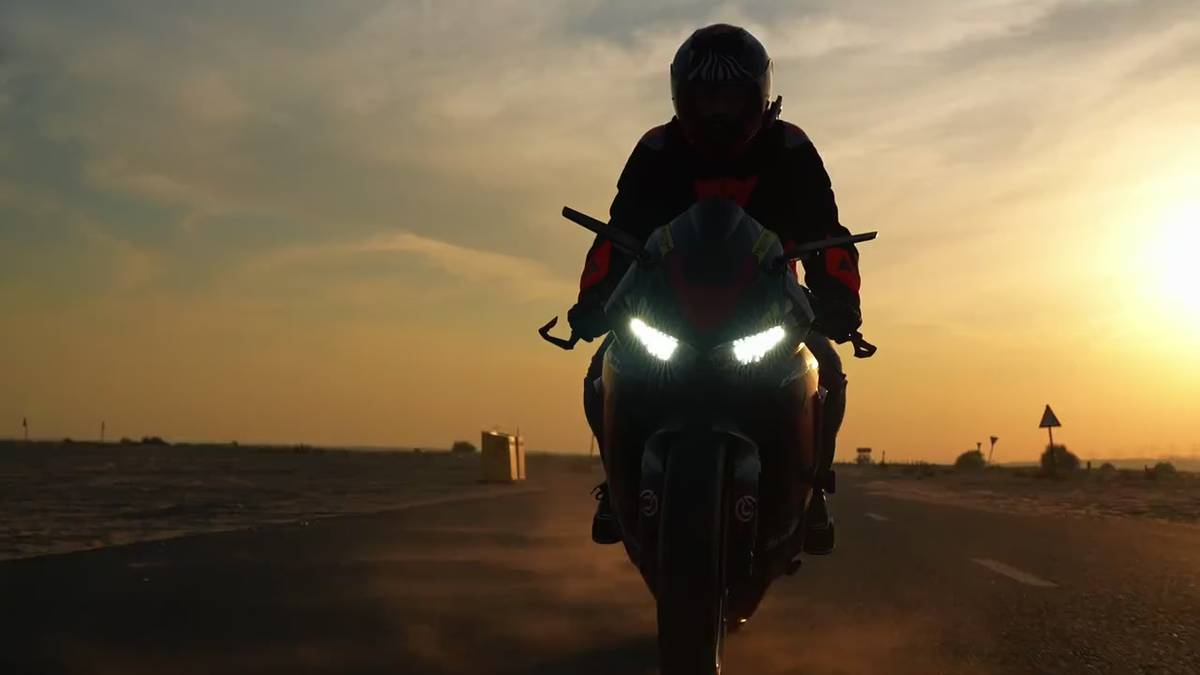
A head-on shot from my desert motorbike film: low, close and steady, the look every moving shot is after.
Roads, permits and the police
Every commercial shoot in Dubai needs a permit from the Dubai Film and TV Commission, and that includes filming a car on a public road. I've covered the process step by step in my guide to filming permits in Dubai, so here's only what's specific to cars.
- Driving normally in traffic is the simplest case: the car follows the rules, the camera car follows the rules, and the permit covers the location.
- Holding traffic or closing a lane needs the Roads and Transport Authority's approval on top of the filming permit, with a traffic management plan. Dubai Police also offer traffic and security support to productions. Plan weeks, not days, for anything that stops traffic.
- Speed, drifting and stunts never happen on open roads. That's what a closed road or a track is for.
- Private land, like a hotel driveway or a developer's site, needs the owner's written approval as well as the permit. Private location fees in Dubai go up to AED 25,000 a day, and the owner sets them.
The DFTC application fee itself is small, around AED 500 to 520. On a road, the real costs are the extras: police presence, a closure and traffic plan, insurance, a government location fee where it applies, and the weeks it takes to plan.
Dubai Autodrome and private tracks
When the brief says speed, I look at a track before I look at a road.
Dubai Autodrome in MotorCity is an FIA-sanctioned circuit, 5.39 km on its Grand Prix layout, with several shorter configurations, a pit lane and the kartdrome next door. The track can be hired privately, and the rate is agreed directly with the venue. For a production, that means no traffic, no police plan for closures, repeatable runs at real speed, and clean backgrounds of tarmac, kerbs and sky.
A few things to know before you book:
- The calendar fills up in winter. It's the busy season for racing and track days, so lock dates early.
- Ask what's included. Track time, marshals, medical cover and pit garage access are often separate items.
- A track looks like a track. Perfect for performance cars and launch films about speed. Less so for a family SUV, which belongs on a road, a beach or in the desert.
A track shoot still needs the DFTC filming permit with the Autodrome listed as the location, so book the venue first and apply straight after.
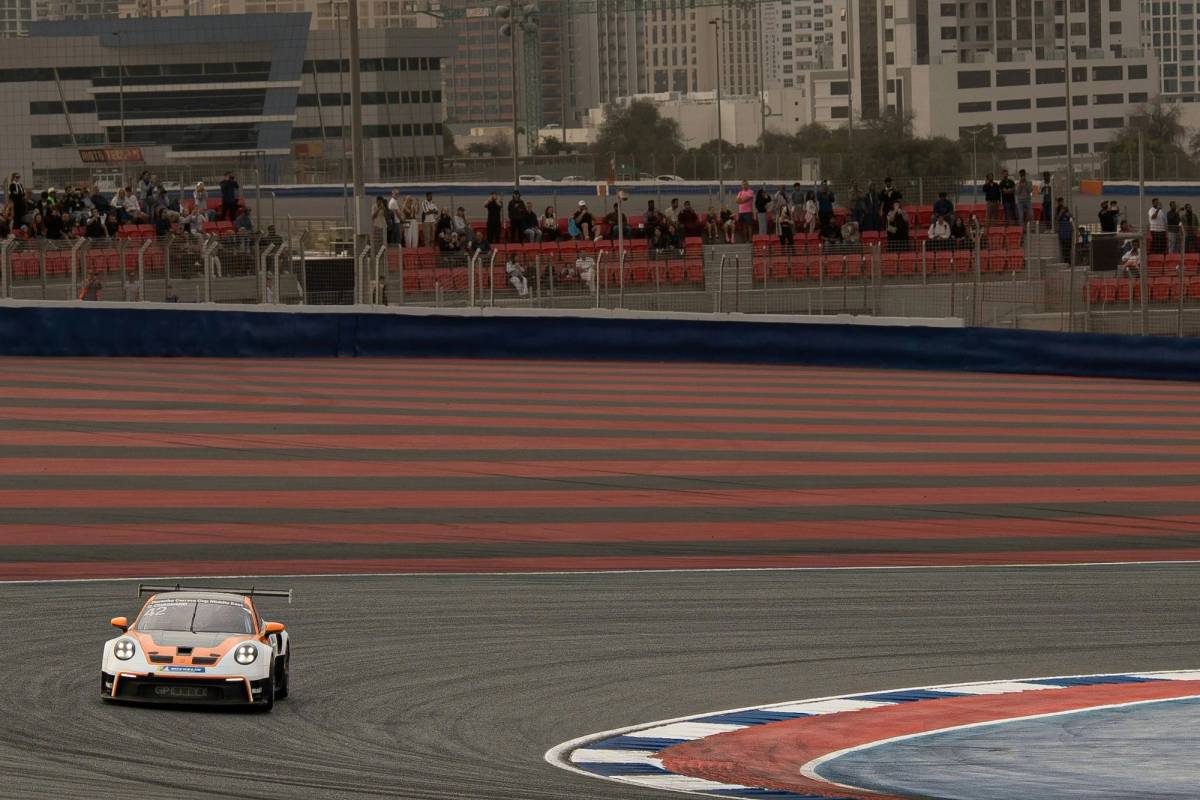
Dubai Autodrome during the 2026 Porsche Carrera Cup Middle East. Photo: Luan Fonseca / Unsplash
Desert days
The desert is why many car brands come to Dubai. Empty roads, dunes, huge skies, all within an hour of the city. It's also the location that punishes poor planning fastest.
- Light. The sun climbs fast and gets harsh by mid-morning. The useful windows are roughly the first and last hour of daylight. A desert day often means a 4 am call, a long break, then sunset.
- Heat. From 15 June to 15 September, UAE rules ban outdoor work in direct sun between 12:30 pm and 3 pm. Plan the shoot around that window. Cameras overheat too, so bring shade for the kit, spare batteries and an insulated case (no ice packs: cold lenses fog up).
- Sand. Change lenses inside a vehicle, never in the wind. Keep a blower and lens cloths on every camera. Sand in a gimbal motor can end a shoot.
- Access. Off-road locations need 4x4 support vehicles and a recovery plan. Some desert areas are protected reserves, private land or restricted zones, so the exact spot goes on the permit like any other location.
I scout the location at the same time of day as the shoot. A dune that looks perfect at noon can be in shadow at the hour you need it.
When I filmed the desert motorbike ride in my portfolio, every shot was planned for low sun: the road shots, the silhouettes and the drone sequence.
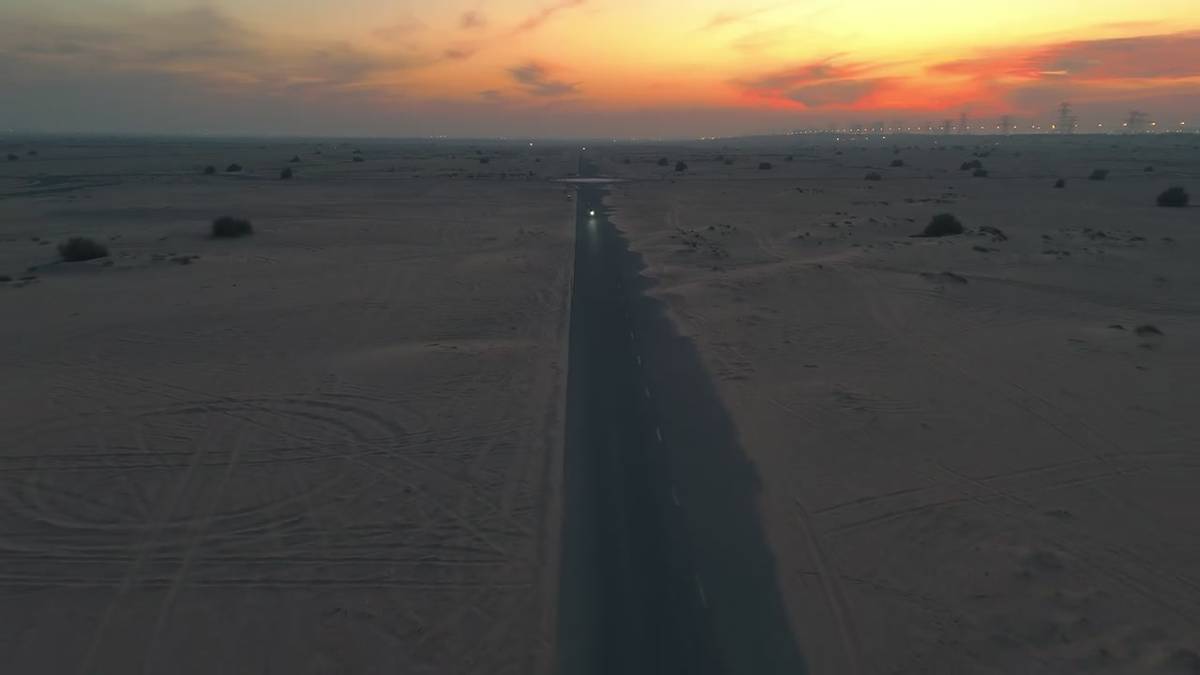
A drone shot from my desert motorbike film. On a road this empty, the vehicle can be a speck and still carry the frame.
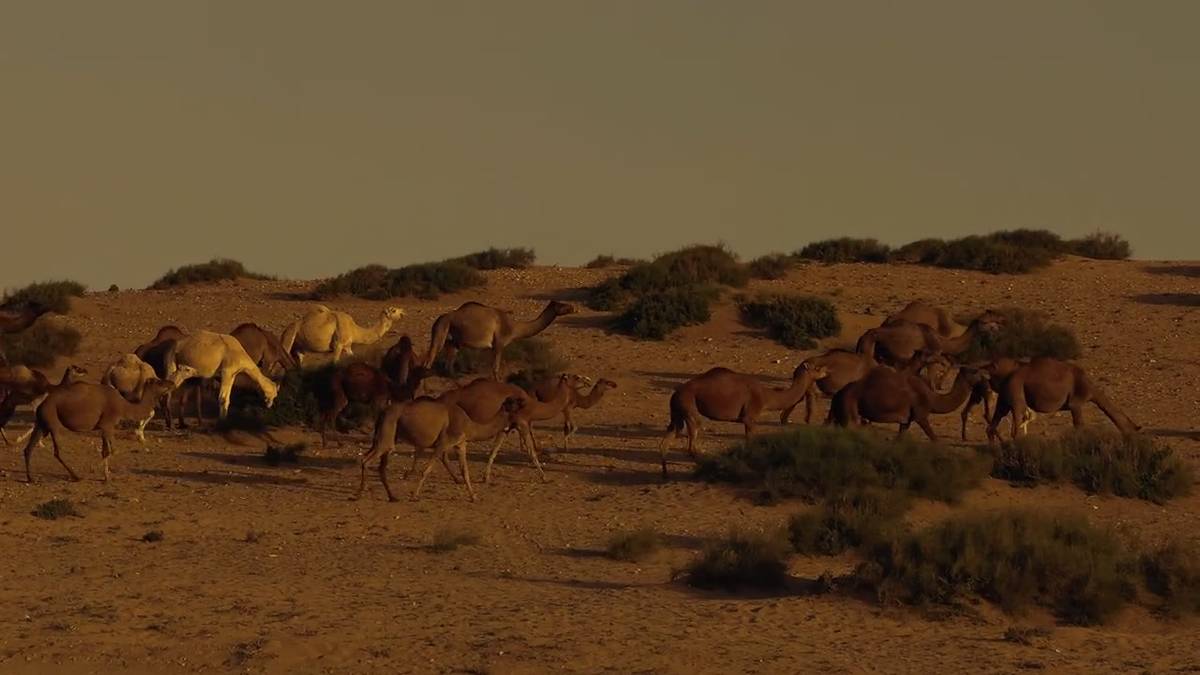
Camels crossing during the same shoot. In the desert you schedule around the light, and sometimes around the herds.
Making paint and chrome look right
Paint is a mirror. Most of the work on a car shoot is controlling what that mirror reflects.
- Use a polarising filter, and turn it for every shot. It cuts reflections on paint and glass, but never all of them, and the right setting changes with every angle.
- Choose the angle for the reflection, not just the car. A building, a crew member or the sky will appear on the doors. Move the camera a metre and the problem often goes away.
- Black cars show everything: dust, swirl marks, fingerprints. White cars burn out in midday sun. Both look their best in soft, low light.
- Clean between takes. Dubai dust settles in minutes. Someone on set should own the car's appearance with a detailing kit, and nobody else touches it.
- Watch the screens and LEDs. UAE mains power runs at 50 Hz, so under artificial light the camera needs a shutter of 1/50 or 1/100 of a second to avoid flicker. Dashboard screens and LED headlights can flicker on their own frequency too, so check every interior shot on a proper monitor, not just the camera's small screen.
Dealers and showrooms
Dealer content works differently. The goal isn't one beautiful film, it's a steady flow of useful videos that sell cars this month.
- Fix a template. The same angles, the same order, the same light for every walkaround. Viewers compare cars, so consistency matters more than variety.
- Batch the shoot. Line up the cars, prepare them all, then film them one after another. Half a day of planning saves days of shooting.
- Bring your own light. Showroom lighting is designed for people walking around, not for cameras. A couple of soft lights and a polariser make a big difference.
- Film the moments that build trust. A real handover, a service technician explaining a fix, a salesperson answering the question everyone asks.
If you're exhibiting at Automechanika Dubai, which runs 9 to 11 November 2027 at Dubai Exhibition Centre in Expo City, the same planning applies to stand content. I've written about exhibition video in Dubai separately.
Budget and timeline
Most of the cost in a car film is people and access: drivers, the camera car, the track or the road plan, and the crew days. For context, a full shoot day with director, camera, drone and lighting runs AED 15,000 to 25,000 (see video production in Dubai), and my guide to what video production costs in Dubai puts a cinematic brand film or commercial at AED 25,000 to 100,000 and up. Dealer content shot in batches comes in well below that per video.
Timing, for a launch film or commercial:
- Three to four weeks of pre-production: treatment, locations, permits, car logistics. Roads and drones need the longest lead time.
- One to three shoot days, depending on locations and how much moves.
- One to two weeks of edit, grade and sound, plus the social cuts.
A road closure needs more lead time still. And if the car is a pre-launch model, agree early who can see the footage and where it's stored. Leaks usually start on set.
Car videography in Dubai: FAQ
How much does car videography cost in Dubai?
A full crew day costs around AED 15,000 to 25,000. A cinematic launch film or commercial usually lands between AED 25,000 and 100,000 or more, depending on the camera car, locations, track hire and talent. Dealer content shot in batches costs much less per video.
Do I need a permit to film a car on Dubai roads?
Yes. Commercial filming in Dubai needs a permit from the Dubai Film and TV Commission, roads included. Holding traffic or closing a lane also needs the Roads and Transport Authority's approval and a traffic management plan.
Can you film at Dubai Autodrome?
Yes. The circuit in MotorCity can be hired privately, and the rate is agreed with the venue. It's the safest place in Dubai to film cars at real speed, with no traffic and repeatable runs.
What's the best time of day to film cars in Dubai?
The first and last hour of daylight. The sun is high and harsh most of the day, which blows out white paint and shows every flaw on black. From 15 June to 15 September, outdoor work in direct sun is also banned between 12:30 pm and 3 pm.
How long does a car launch video take to produce?
About five to seven weeks from brief to delivery: three to four weeks of pre-production and permits, one to three shoot days, and one to two weeks of edit and grade. Road closures add lead time.
Can you shoot car photos and video on the same day?
Yes, but book a photographer as well. Photos and video need different angles and timing for the same moments, and one person can't do both well during a tracking shot.
Planning a car shoot in Dubai?
Send me the model, where the film will be played and your date, and I'll tell you how I'd shoot it. You can see the rest of my work in video production in Dubai, and the Mount Med case study shows how I build a brand film around real people.